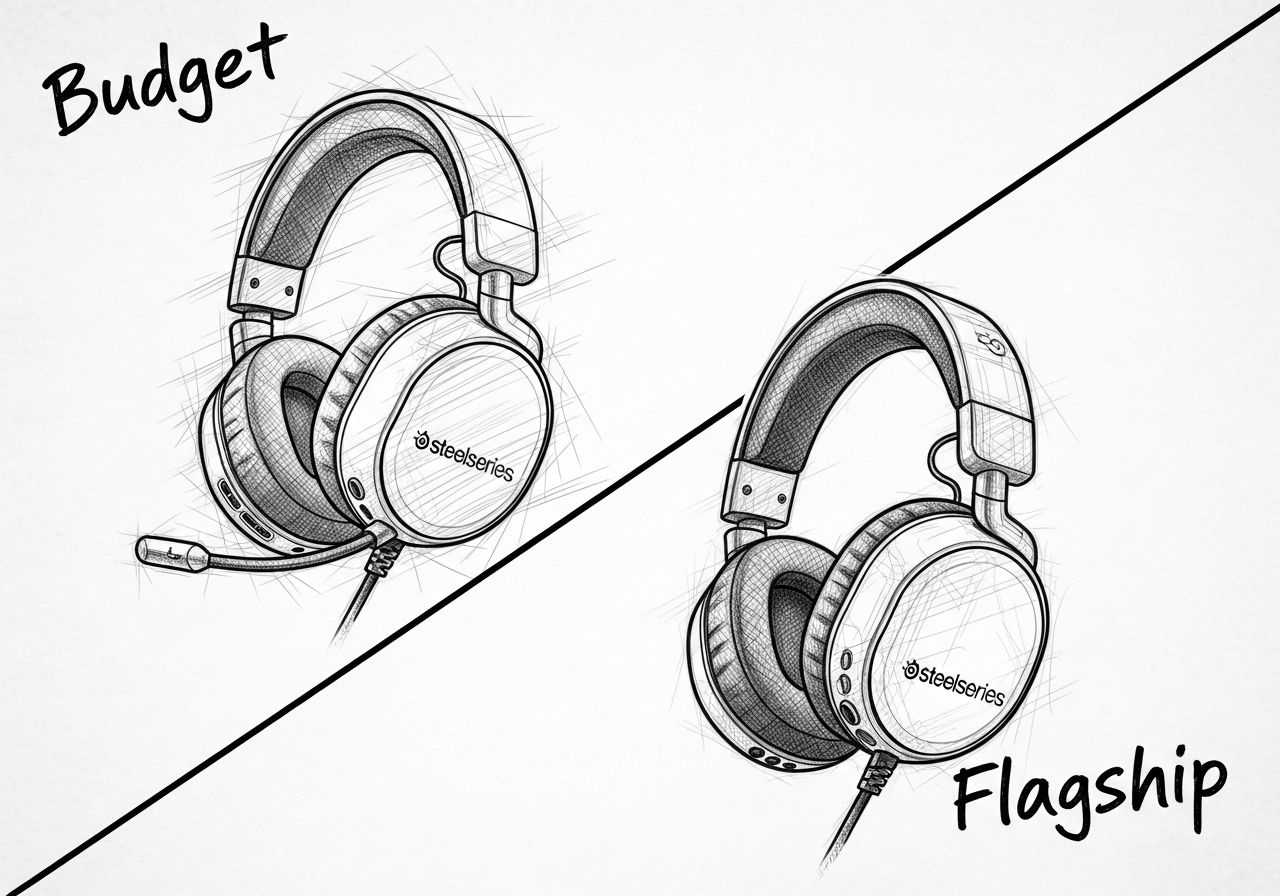
Budget vs Flagship: SteelSeries Arctis Nova 1 vs Arctis Nova Elite
Discover which SteelSeries headsets actually make a difference when gaming for extended periods.
When shopping for a gaming headset, one question always looms large: is the flagship model really worth ten times the price of the budget option? With SteelSeries’ latest lineup, this question becomes particularly interesting. The Arctis Nova 1 costs just $60, while the newly released Arctis Nova Elite commands a staggering $600. That’s a $540 difference for two headsets from the same family. Let’s dig into whether that premium price tag delivers ten times the value.
Nova 1 vs Nova Elite
Compare the budget beast with the ultra-flagship side-by-side.
Key Specifications
| Tech Specs | SteelSeries Arctis Nova 1 | SteelSeries Arctis Nova Elite |
|---|---|---|
| Price | $59.99 | $599.99 |
| Ideal Fit | Medium Head | Medium-Large Head |
| Battery Life | 30h | |
| Connection | Wired | Wireless |
| Microphone Type | Retractable Boom Mic | Retractable Boom Mic |
| Driver Type | Dynamic | Graphene |
| Driver Size | 40mm | 40mm |
| Weight | 236g | 380g |
| NC Mic | ||
| ANC Features | ||
| Mic Monitoring |
Community Consensus
Calculated from thousands of user reviews, Reddit sentiment, and professional scores to determine the "real world" tier of each feature.
| Quality Tier | SteelSeries Arctis Nova 1 | SteelSeries Arctis Nova Elite |
|---|---|---|
| Audio | B Tier | S Tier |
| Comfort | A Tier | A Tier |
| Build Quality | B Tier | S Tier |
| Microphone | B Tier | A Tier |
| Wireless | S Tier |
Arctis Nova 1: The Budget Champion
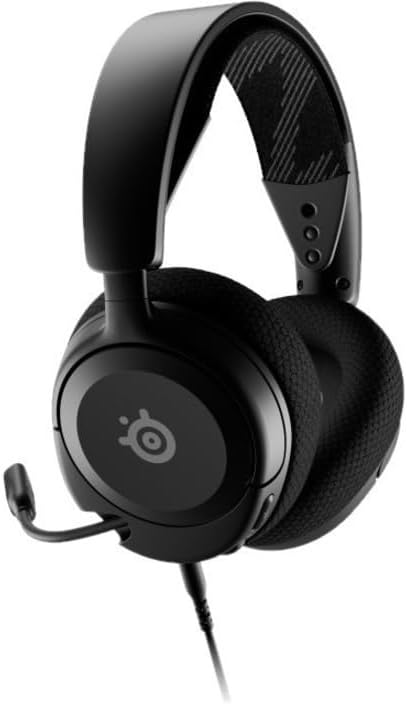
Released in 2022, the Arctis Nova 1 represents SteelSeries’ entry point into their Nova lineup. It’s a wired-only headset that strips away all the bells and whistles to focus on fundamentals: comfort, sound quality, and universal compatibility through its 3.5mm connection. At 236 grams, it’s one of the lightest gaming headsets available, featuring the signature SteelSeries ski-goggle suspension headband and 40mm custom drivers.
Arctis Nova Elite: The New Flagship
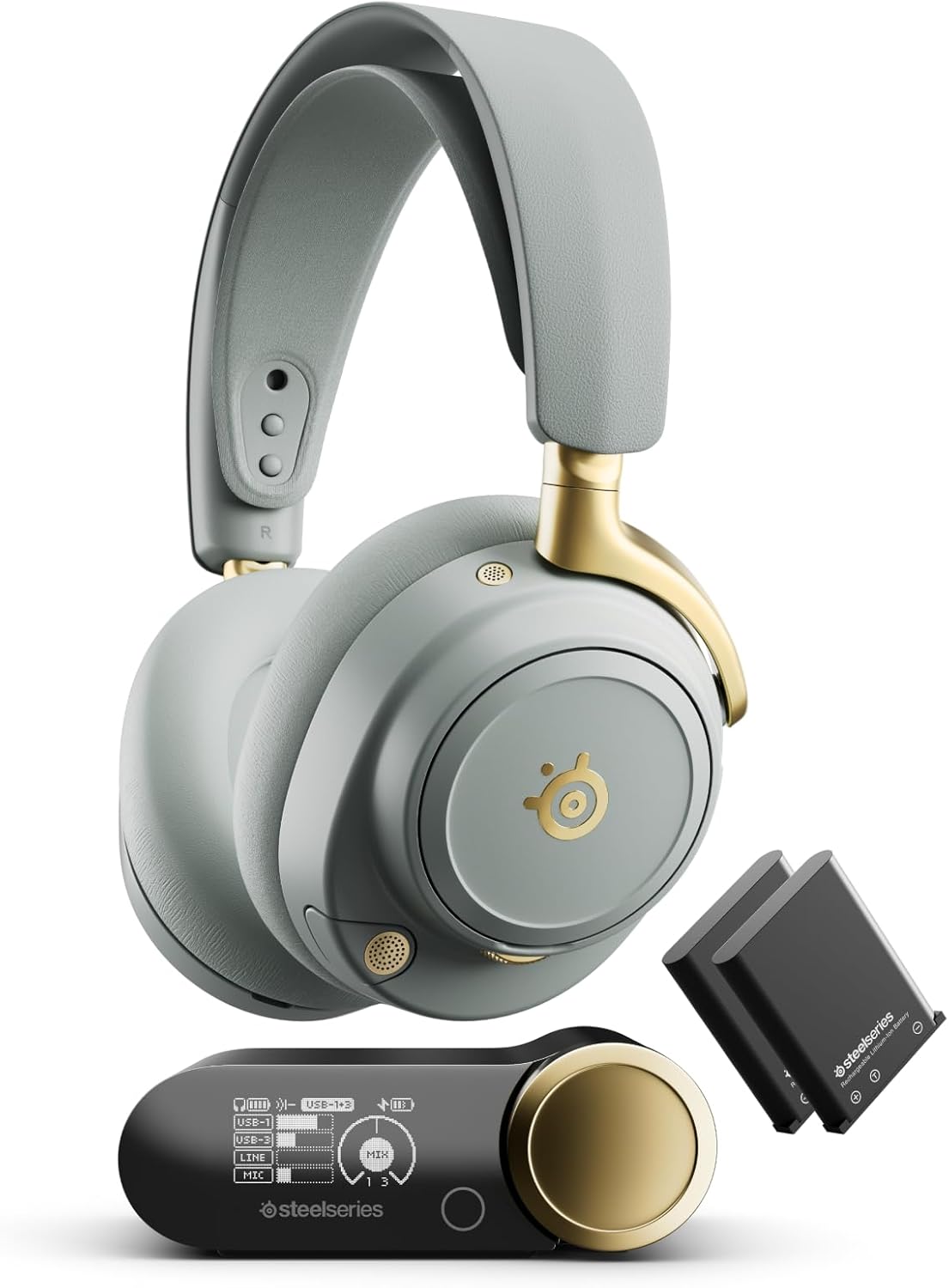
Launched in September 2025, the Arctis Nova Elite represents SteelSeries’ most ambitious headset to date. It’s the world’s first Hi-Res Wireless Certified gaming headset, featuring carbon fiber drivers, active noise cancellation, and a GameHub that can simultaneously connect to four different audio sources. With its all-metal frame, leather accents, and Danish-designed aesthetic, this headset positions itself as both a premium gaming tool and an everyday luxury audio device.
Build Quality and Comfort
The differences in construction are immediately apparent when you pick up each headset. The Nova 1 is almost entirely plastic, which keeps it feather-light but doesn’t exactly scream premium. That said, the build quality is solid for the price point, and the lightweight design translates to exceptional all-day comfort. The stretchy ski-goggle band distributes weight evenly, and the AirWeave memory foam ear cushions keep your ears cool during marathon gaming sessions.
The Nova Elite, by contrast, feels luxurious in hand. The all-metal frame, faux leather headband wrap, and metal control wheel give it a substantial, refined feel. The ear cushions are noticeably plusher with premium memory foam, and every material choice reinforces the luxury positioning. Co-designed with renowned Danish industrial designer Jacob Wagner, the Elite looks and feels like it belongs in Bang & Olufsen’s product lineup rather than a typical gaming peripheral collection.
However, this premium construction comes with a weight penalty. While still comfortable, the Elite is noticeably heavier than the Nova 1. For gamers who prioritize absolute comfort during extended sessions, the Nova 1’s ultralight design might actually be preferable. Several users have noted that the Nova 1 is so light you can forget you’re wearing it—a feat the heavier Elite can’t quite match despite its superior materials.
Sound Quality: The Heart of the Matter
Here’s where things get interesting. Both headsets feature 40mm drivers, though the Elite uses custom carbon fiber drivers with brass surrounds while the Nova 1 uses standard dynamic drivers. The Elite’s drivers can reproduce frequencies from 10Hz to 40kHz and support Hi-Res wireless audio at 96kHz/24-bit on PC—technical specifications that look impressive on paper.
In practice, the Nova 1 delivers surprisingly excellent audio for its price bracket. The sound is well-balanced with controlled bass, clear mids, and decent treble. It won’t compete with audiophile-grade equipment, but for gaming, music, and media consumption, it punches well above its weight class. The clarity is good enough to hear footsteps in competitive shooters, and the soundstage, while not expansive, provides adequate spatial awareness.
The Elite takes things to another level with noticeably superior audio quality. The carbon fiber drivers deliver tighter, more precise bass, exceptional clarity across the frequency range, and a wider soundstage that enhances immersion. The Hi-Res wireless certification isn’t just marketing—when paired with proper source material, the difference is audible. Music sounds more detailed, game audio feels more immersive, and the overall listening experience is refined.
But here’s the crucial question: is the Elite’s audio quality ten times better than the Nova 1? The consensus among reviewers and users is a resounding no. While the Elite sounds noticeably better, the gap isn’t massive. One reviewer noted that if the Elite scores a 10 out of 10 for sound quality, the Nova 1 still manages an 8 or 9. That’s a meaningful difference for audiophiles but not necessarily worth the 10x price premium for most gamers.
Features: Where the Gap Widens
This is where the price difference starts to make more sense. The Nova 1 is deliberately minimal—it’s a plug-and-play wired headset with on-ear volume control and a retractable microphone. That’s it. No wireless, no RGB, no software customization beyond what you can access through SteelSeries’ free Sonar software on PC. The simplicity is both a strength and a limitation.
The Elite, conversely, is packed with premium features:
GameHub Multi-Source Connectivity: The ability to connect up to four audio sources simultaneously—two consoles via USB-C, Bluetooth, and a line-in—is genuinely useful for content creators and multi-platform gamers. You can have your PC, PlayStation, and phone all connected at once, mixing audio on the fly.
Active Noise Cancellation: The Elite features what SteelSeries claims is the best ANC in gaming, reducing ambient noise by up to 89%. It also includes a transparency mode for when you need to hear your surroundings.
Dual Battery System: The Infinite Power System with hot-swappable batteries means you never have to stop gaming to charge. Each battery lasts up to 30 hours, and one charges in the GameHub while you use the other.
AI Microphone Technology: The Elite’s dual-microphone system with AI noise rejection can reportedly eliminate up to 97% of background noise. When you retract the boom mic, it automatically switches to a discreet onboard beamforming mic.
200+ Game Presets: Through the Arctis companion app, you get access to professionally tuned EQ profiles for over 200 games.
Universal Platform Support: Unlike the previous Nova Pro which required choosing between PlayStation or Xbox versions, the Elite works with everything out of the box.
For someone who only plays on one platform and doesn’t need wireless connectivity, most of these features are unnecessary luxuries. But for streamers, content creators, or gamers who switch between multiple platforms, the convenience factor is substantial.
Microphone Performance
Both headsets feature retractable microphones, though the implementations differ significantly. The Nova 1’s ClearCast Gen 2 mic provides bidirectional noise cancellation that reduces background noise by up to 25dB. The mic quality is excellent for a budget headset—clear, bright voice reproduction that’s more than adequate for Discord calls and in-game chat.
The Elite’s microphone system is considerably more sophisticated. The AI-powered noise rejection is genuinely impressive, handling noisy environments far better than traditional noise cancellation. The automatic switching between the boom mic and onboard beamforming mic when you retract it adds convenience, though the onboard mic doesn’t quite match the boom mic’s quality in very loud environments.
For most gamers, the Nova 1’s mic is perfectly sufficient. The Elite’s microphone is objectively better, but unless you’re streaming professionally or taking important calls in chaotic environments, the upgrade may not justify the cost.
Connectivity and Versatility
The Nova 1’s wired 3.5mm connection is its greatest strength and limitation. It works with virtually everything—PC, Mac, PlayStation, Xbox, Switch, Steam Deck, and older smartphones with headphone jacks. There’s no battery to charge, no wireless interference, and no compatibility headaches. However, you’re tethered by a cable, and modern devices without 3.5mm jacks require adapters.
The Elite offers maximum versatility with 2.4GHz wireless, Bluetooth 5.3, and wired 3.5mm connectivity. The wireless implementation is rock-solid with impressive range and minimal latency. The ability to be connected to multiple devices simultaneously is genuinely convenient if your setup warrants it. However, this flexibility comes with the complexity of managing connections, charging batteries, and dealing with occasional software quirks.
Real-World Value Assessment
Let’s be honest about who each headset is for.
The Nova 1 is ideal for:
- Budget-conscious gamers who want solid performance without breaking the bank
- Players who primarily game on one platform with a 3.5mm jack
- Anyone who values simplicity and plug-and-play convenience
- Gamers prioritizing lightweight comfort for extended sessions
- VR gamers who need a lightweight, wired solution
The Elite makes sense for:
- Multi-platform gamers who switch between PC, consoles, and mobile regularly
- Content creators who need to manage multiple audio sources simultaneously
- Audiophiles who can appreciate and afford Hi-Res wireless audio
- Professionals using their headset for work, gaming, and daily listening
- Those who want a single premium headset to replace multiple devices
The Verdict
The Arctis Nova 1 is one of the best values in gaming headsets today. For $60, you get excellent comfort, surprisingly good audio quality, a solid microphone, and universal compatibility. It does exactly what it needs to do without pretense or unnecessary complications. Most gamers would be completely satisfied with this headset.
The Arctis Nova Elite is an exceptional piece of hardware that pushes the boundaries of what a gaming headset can be. The Hi-Res wireless audio is legitimate, the build quality is superb, and the multi-source connectivity solves real problems for certain users. However, it’s undeniably expensive, and the performance improvements over much cheaper options like the Nova 1 don’t scale linearly with the price increase.
If you can only afford $60-100, the Nova 1 is an easy recommendation. You’re not missing out on essentials.
If you have $200-300 to spend, consider the Arctis Nova 5 or Nova 7, which offer wireless connectivity and more features at a fraction of the Elite’s cost.
If you have $600 and the Elite’s feature set aligns with your needs—multi-platform gaming, professional streaming, or desire for the absolute best—then the Elite won’t disappoint. Just know you’re paying for luxury and convenience, not a proportional performance increase.
The gaming headset market follows the law of diminishing returns. The Nova 1 gets you 80% of the experience for 10% of the price. The Elite delivers the remaining 20% with exceptional polish, but only you can decide if that final 20% is worth the premium. For most gamers, the honest answer is no—but for those who can appreciate and utilize everything the Elite offers, it’s a remarkable piece of technology that justifies its place at the top of the lineup.
Featured Products
Products mentioned in this article
SteelSeriesArctis Nova 1
SteelSeriesArctis Nova Elite

Richard Scott
Headset Expert & Web Developer
Web developer and lifelong gamer. Spends too much time on golf, hockey, and finding the right headset. Lives with a dog who has no opinions on audio quality.